Archive for the ‘WUWT’ Category

Maryland’s “Wind Powered Welfare”

March 12, 2013

Going Green

Offshore Wind Passes in Senate, Gov. O’Malley’s Signature Next


The construction of a wind power farm off the coast of Ocean City could begin as early at 2017

By Jessica Wilde, Capital News Service

Gov. Martin O’Malley’s offshore wind energy bill is on its way to his desk for a signature, having passed in the House in February and in the Senate on Friday.

Five friendly Senate amendments are expected to be approved easily by the House.

The new legislation will funnel $1.7 billion of ratepayer subsidies over a 20-year period toward the construction of a wind power farm 10 to 30 miles off the coast of Ocean City as early as 2017.

“It’s about a better Maryland for tomorrow,” said Sen. James Mathias Jr., D-Worcester, the former mayor of Ocean City, who changed his vote to support the bill.

O’Malley’s previous two attempts to push the legislation—the first more ambitious —never made it to the Senate floor largely because of concerns about the cost to Marylanders.

His first initiative also failed because utility companies would have had to make nearly 20-year commitments to buy offshore wind energy.

[...]

GreenbeltPatch

Offshore wind is, by far, the most expensive source of electricity. An offshore wind farm would have to receive 34¢/kWh, wholesale, just to break even over a typical 30-yr plant lifetime. 34¢/kWh is almost three times the average retail residential electricity rate in the U.S.

(more…)

A Simple Test of Marcott et al., 2012

March 11, 2013

The Gorebots are al atwitter about this new paper…

Science 8 March 2013:
Vol. 339 no. 6124 pp. 1198-1201
DOI: 10.1126/science.1228026

A Reconstruction of Regional and Global Temperature for the Past 11,300 Years

Shaun A. Marcott, Jeremy D. Shakun, Peter U. Clark, Alan C. Mix

Surface temperature reconstructions of the past 1500 years suggest that recent warming is unprecedented in that time. Here we provide a broader perspective by reconstructing regional and global temperature anomalies for the past 11,300 years from 73 globally distributed records. Early Holocene (10,000 to 5000 years ago) warmth is followed by ~0.7°C cooling through the middle to late Holocene (<5000 years ago), culminating in the coolest temperatures of the Holocene during the Little Ice Age, about 200 years ago. This cooling is largely associated with ~2°C change in the North Atlantic. Current global temperatures of the past decade have not yet exceeded peak interglacial values but are warmer than during ~75% of the Holocene temperature history. Intergovernmental Panel on Climate Change model projections for 2100 exceed the full distribution of Holocene temperature under all plausible greenhouse gas emission scenarios.

Science

Marcott et al., 2012 is behind a paywall; however the supplementary materials include a link to their proxy data.

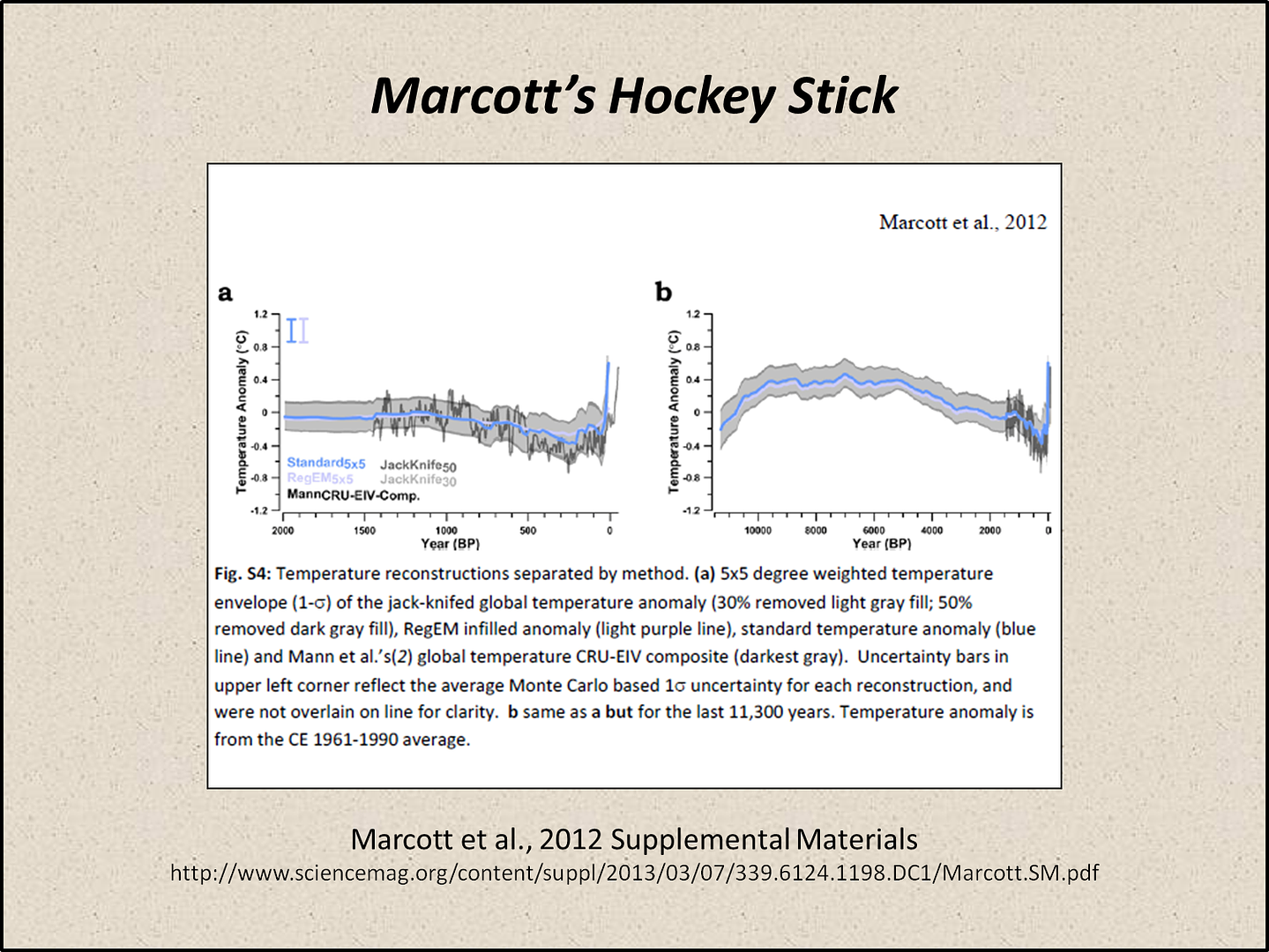
This paper appears to be a text book example of creating a Hockey Stick by using a low resolution time series for the handle and a high resolution time series for the blade…

Let’s test one of the 73 proxies.

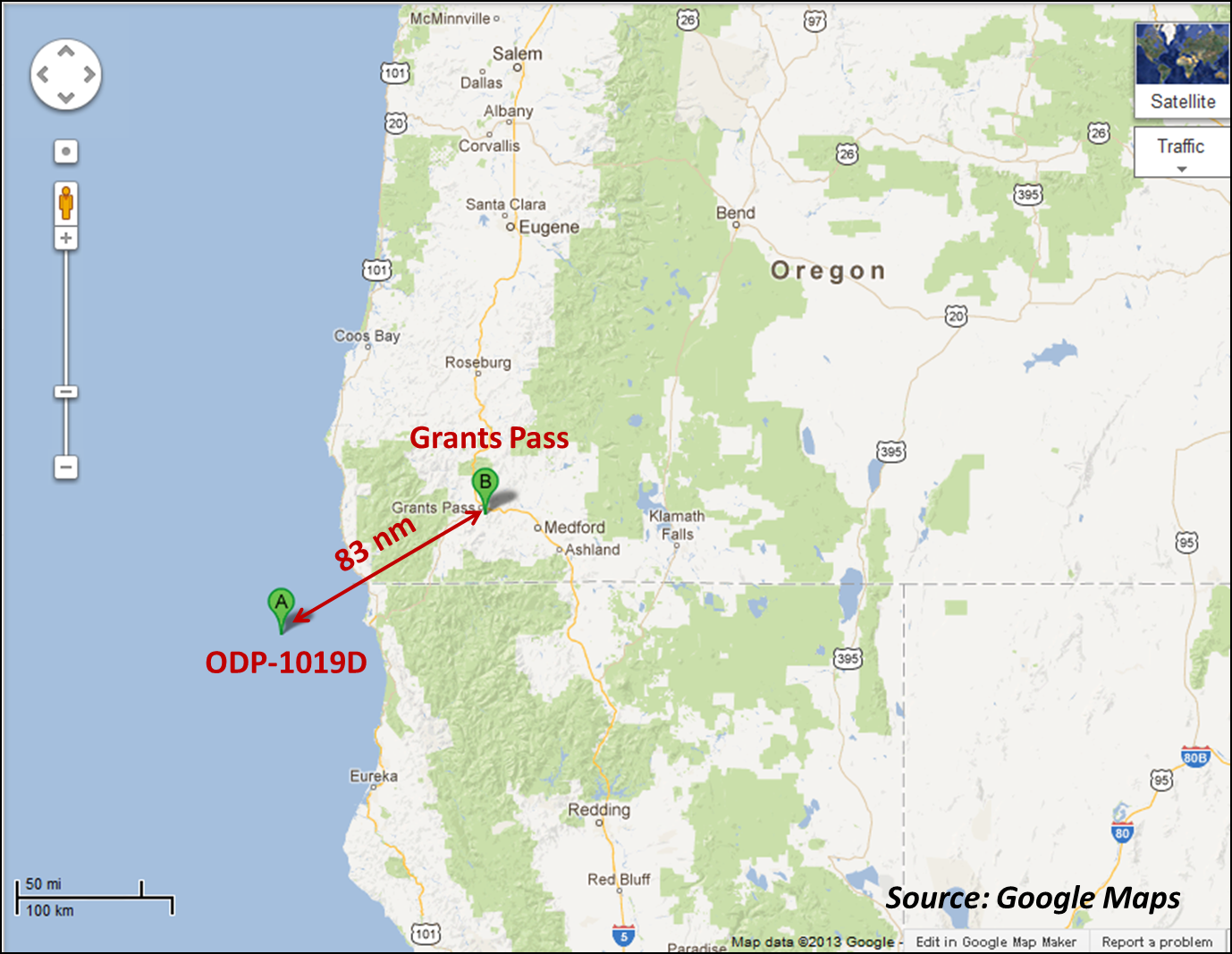
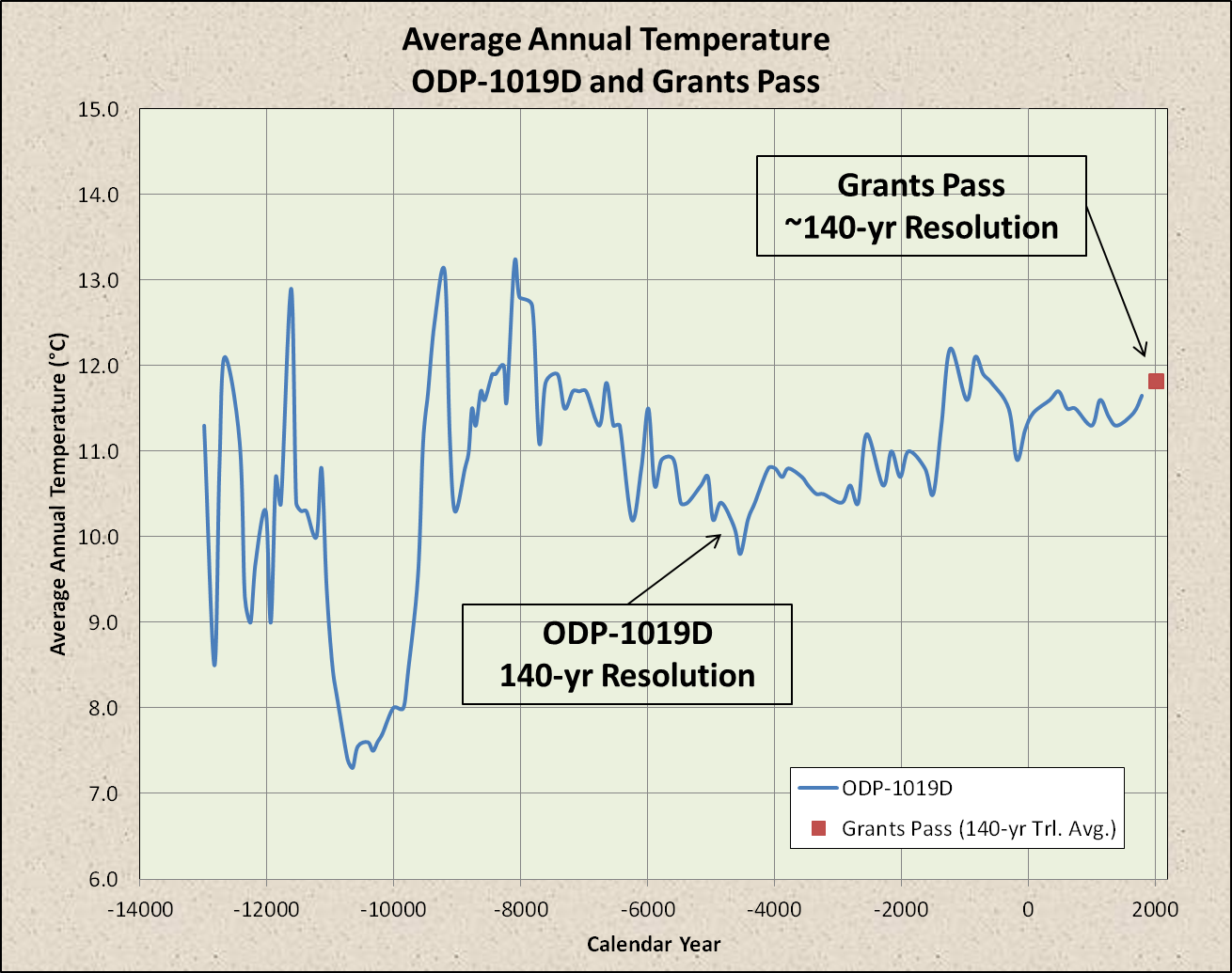
I picked ODP-1019D, a marine sediment core from just offshore of the California-Oregon border because it has a long time series, is a an annual reconstruction and has a nearby long time series instrumental record (Grants Pass OR).

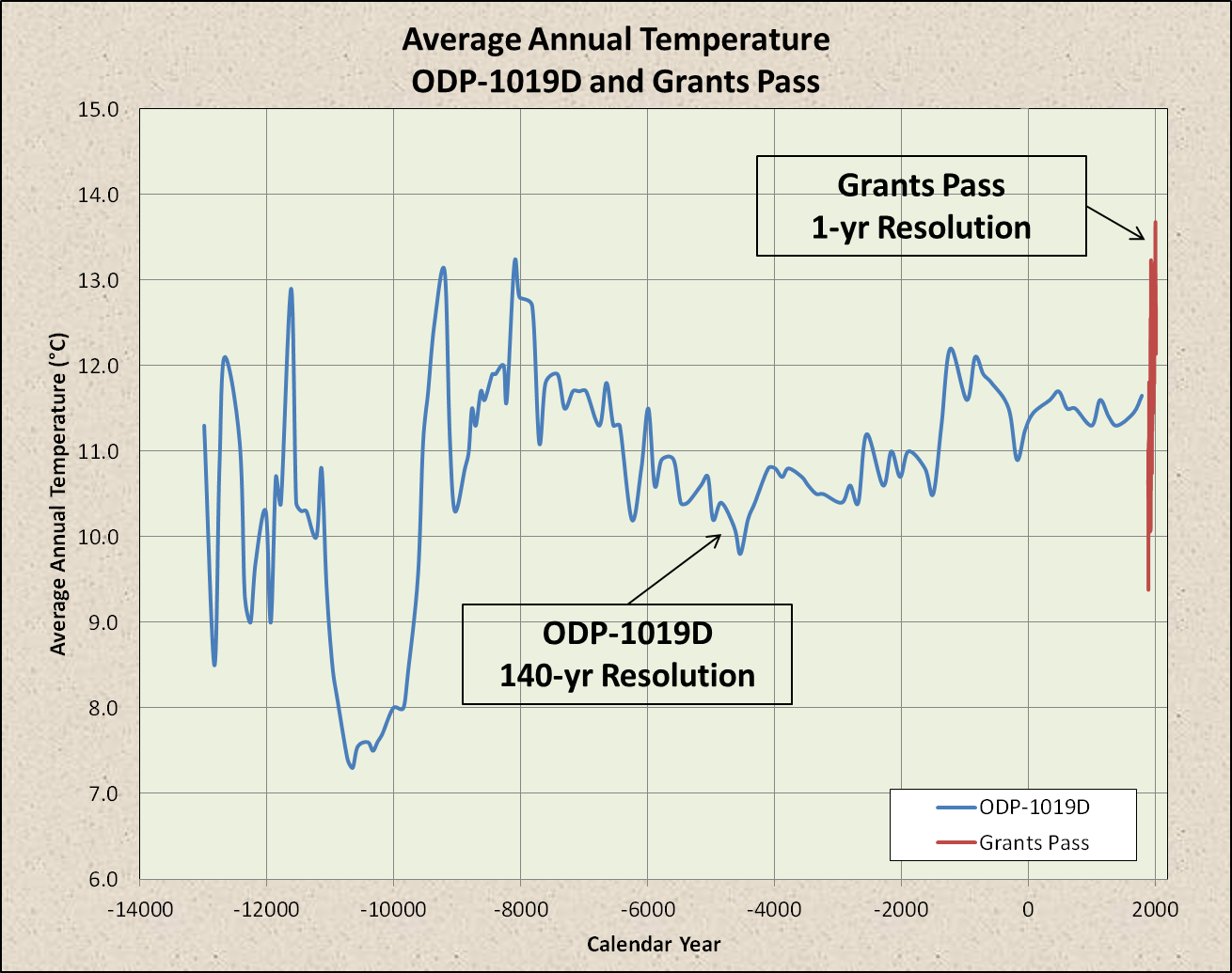
ODP-1019D has a resolution of 140 years. Grants Pass is annually resolved…

Let’s filter Grants Pass down to the resolution of the Marcott et al. reconstruction…

Grants Pass sure looks very anomalous relative to the rest of the Holocene… Right?

Well, not so fast. ODP1019D only has a 140-yr resolution. The record length at Grants Pass is less than 140 years. So, the entire Grants Pass record would be a single data point in the ODP-1019D record…

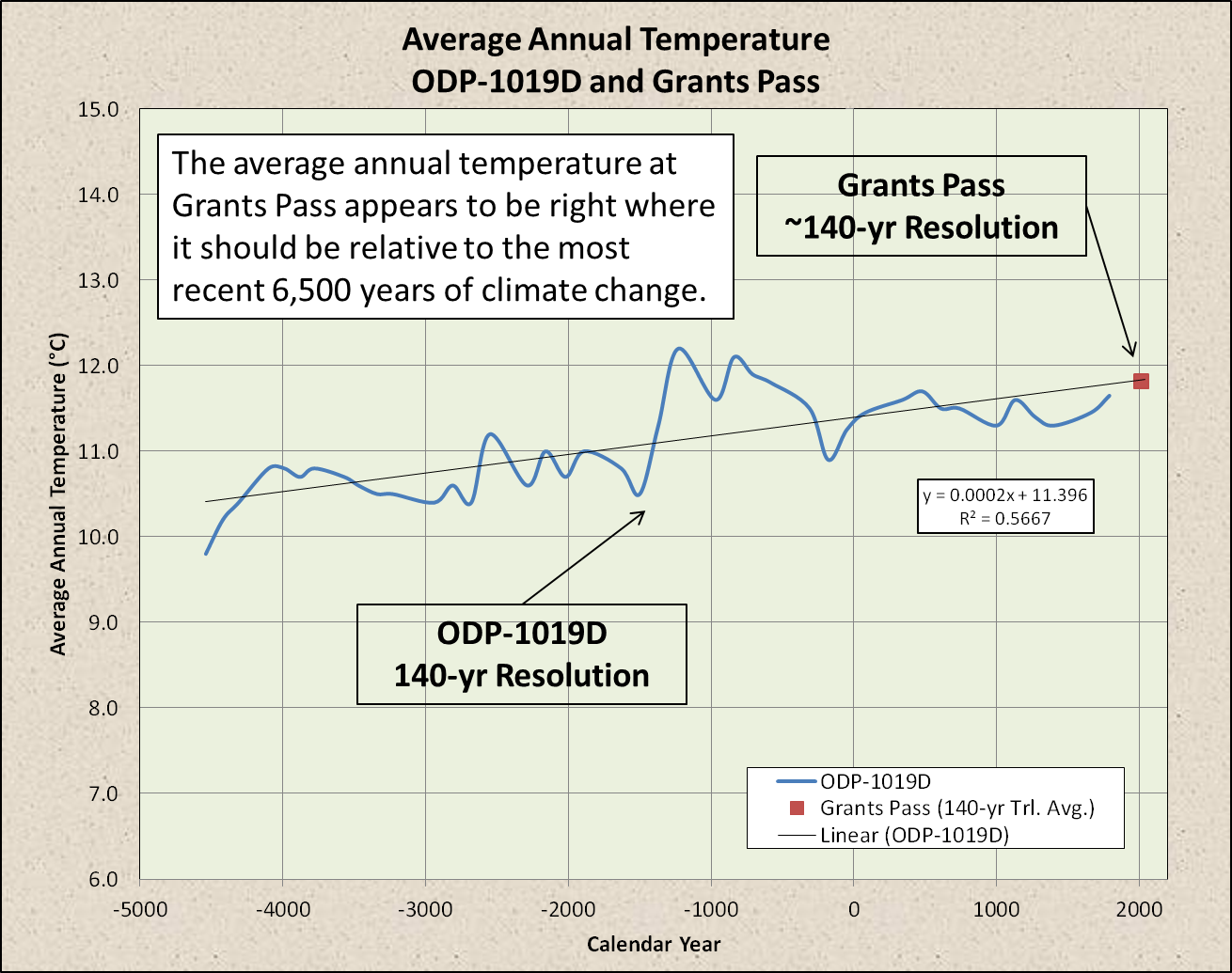
While, the most recent ~140 years might be warmer than most of the rest of the Holocene in this particular area, does anyone else notice what I did?

The Grants Pass/ODP-1019D area has been warming at a fairly steady rate for 6,500 years…

I don’t know how many of these proxies I will have time to analyze… Probably not very many. Maybe this could become a WUWT crowd-sourcing project.

“A [Junk] Scientist’s Misguided Crusade” Against Keystone XL

March 5, 2013

More improper activity from the Million Dollar Bureaucrat

A Scientist’s Misguided Crusade

By JOE NOCERA
Published: March 4, 2013

Last Friday, at 3:40 p.m., the State Department released its “Draft Supplemental Environmental Impact Statement” for the highly contentious Keystone XL pipeline, which Canada hopes to build to move its tar sands oil to refineries in the United States. In effect, the statement said there were no environmental impediments that would prevent President Obama from approving the pipeline.

Two hours and 20 minutes later, I received a blast e-mail containing a statement by James Hansen, the head of the Goddard Institute for Space Studies at NASA — i.e., NASA’s chief climate scientist. “Keystone XL, if the public were to allow our well-oiled government to shepherd it into existence, would be the first step down the wrong road, perpetuating our addiction to dirty fossil fuels, moving to ever dirtier ones,” it began. After claiming that the carbon in the tar sands “exceeds that in all oil burned in human history,” Hansen’s statement concluded: “The public must demand that the government begin serving the public’s interest, not the fossil fuel industry’s interest.”

As a private citizen, Hansen, 71, has the same First Amendment rights as everyone else. He can publicly oppose the Keystone XL pipeline if he so chooses, just as he can be as politically active as he wants to be in the anti-Keystone movement, and even be arrested during protests, something he managed to do recently in front of the White House.

But the blast e-mail didn’t come from James Hansen, private citizen. It specifically identified Hansen as the head of the Goddard Institute

[...]

Yet what people hear from Hansen today is not so much his science but his broad, unscientific views on, say, the evils of oil companies.

[...]

For a midlevel scientist at the Goddard Institute, what signal is Hansen sending when he takes the day off to get arrested at the White House? Do his colleagues feel unfettered in their own work? There is, in fact, enormous resentment toward Hansen inside NASA, where many officials feel that their solid, analytical work on climate science is being lost in what many of them describe as “the Hansen sideshow.”

[...]

NYT OpEd

Hansen should be fired and prosecuted for misusing his office and title as a NASA director in an effort to push his political agenda (the Hatch Act).

The Hatch Act grew out of nineteenth-century concerns about the political activities of federal employees. As early as 1801, President Thomas Jefferson issued an Executive Order that said federal workers should neither “influence the votes of others, nor take part in the business of electioneering.” He saw such activities as “inconsistent with the spirit of the Constitution.” Jefferson was primarily concerned with what government employees did while in office; subsequently, concerns developed in another area. Throughout the nineteenth century, appointments to the federal bureaucracy were viewed as the natural spoils of political success. The prevalent awarding of jobs for political loyalty created a so-called spoils system and, ultimately, a reaction against it.


LINK

Global Warming to Endanger Breakfast by 2080!!!

February 27, 2013

First it was wheat and now it’s coffee.  What’s next? Bacon & eggs?

This is nothing but alarmist nonsense…

Researchers at the Royal Botanic Gardens in Kew and the Environment and Coffee Forest Forum in Addis Ababa, Ethiopia looked at how climate change might make some land unsuitable for Arabica plants, which are highly vulnerable to temperature change and other dangers including pests and disease.

They came up with a best-case scenario that predicts a 38 per cent reduction in land capable of yielding Arabica by 2080. The worst-case scenario puts the loss at between 90 per cent and 100 per cent.

If global climate warming change disruption is likely to wipe out the most prevalent coffee bean in a few decades, the previous few hundred years of warming should have “left a mark” on global coffee production… Right?

I downloaded the latest HadCRUT4 temperature and Mauna Loa CO2 data from Wood for Trees and global coffee bean production from FAOSTAT and it appears that coffee bean trees like warmer temperatures…

And they really like a carbon dioxide-rich diet…

The “how climate change might make some land unsuitable” model was built from the IPCC’s totally bogus emissions scenarios. The modeled scenarios A1B, A2A and B2A.

The models say that “business as usual” will lead to A1-type scenarios (turn Earth into Venus and wipe out coffee). The models say that drastic cuts in carbon emissions are required to stay in the B2-type scenario range.

The actual data indicate that the B2-type scenario is the worst case possibility if we keep “business as usual”. 

Furthermore, HadCRUT4 shows absolutely no global warming since late 2000…

Now, if I take HadCRUT4 back to the beginning of 1997, I get this…

(Note: I built this graph back in November.)

Let’s look at the equation of the trend line:

y = 0.0048x – 9.2567

The key part of the equation is the number right before “x.” That’s what’s called the “slope” of the function. The slope is 0.0048 °C per year. This works out to about half-a-degree (0.5 °C) Celsius per century. For reference purposes, the IPCC “forecasted” 1.8 to 4.0 °C per century over the next 100 years, depending on their various socioeconomic scenarios. Here’s the real kicker… The IPCC “forecasted” 0.6 °C of warming over the next century in a scenario in which CO2 remains at the same level as it was in 2000. This is reminiscent of Hanson’s failed 1988 model. The IPCC forecast more warming in a steady-state CO2 world than has actually occurred since 1997.

Now let’s look at the “R²” value…

R² = 0.0334

R² is the “coefficient of determination.” It tells us how well the trend line fits the data. An R² of 1.0 would be a perfect fit. An R² of 0.0 would be no fit. 0.0334 is a lot closer to 0.0 than it is to 1.0. R² is related to explained variance. The linear trend line “explains” about 3.3% of the variation in the temperature data since 1997. 96.7% of the variation was due to natural climatic oscillations (quasi-periodic fluctuations, if you prefer) and stochastic variability.

The scenarios in which coffee beans *might* be threatened, “forecasted” 1.8 to 4.0 °C of warming in the 21st century based on “business as usual” carbon emissions. The actual warming since 1998 has been less than the scenario in which atmospheric CO2 levels stopped rising at the beginning of this century.

Data Sources:

Food and Agriculture Organization of the United Nations, FAO Statistics Division.  Coffee bean data downloaded on Feb. 27, 2013.

Hadley Centre.  HadCRUT4 tropical temperature data downloaded on February 27, 2013 from Wood for Trees.

NOAA Earth System Research Laboratory.  Mauna Loa CO2 data downloaded on February 27, 2013 from Wood for Trees.

Is Yoko Ono smarter than a 4th grader?

January 14, 2013

First up: Yoko Ono and friends…

‘Fracking kills’: Yoko Ono joins star-studded cast fighting against hydraulic natural gas drilling in upstate New York

John Lennon’s son Sean Lennon, actress Debra Winger, songstress Natalie Merchant and “The Avengers” actor Mark Ruffalo have also spoken out in opposition to the extraction process criticized for potentially contaminating water supplies and damaging the environment.

By Glenn Blain / NEW YORK DAILY NEWS
Published: Friday, January 11, 2013

ALBANY — Hydrofracking is not the most glamorous of issues but the gritty subject is bringing a lot of glitz to the state Capitol.

Yoko Ono, the widow of ex-Beatle John Lennon, and son Sean Lennon became the latest celebrities to visit Albany Friday to press for a ban on the controversial natural gas drilling.

“Fracking kills,” Ono said at a press conference with other drilling opponents. “And it doesn’t just kill us, it kills the land, nature and eventually the whole world.”

[...]

NY Daily News

Now it’s the 4th graders’ turn…

Fourth-graders have concluded fracking’s bad

By Steve Israel
Published: 2:00 AM – 01/13/13
If it were up to nearly four dozen future voters at a Middletown elementary school, fracking would be banned in New York — and the rest of the world.

Just listen to what those fourth-graders at Maple Hill Elementary School have to say about the controversial natural gas extraction method of hydraulic fracturing, or fracking:

“It could cause methane explosions, poison water and kill people. It killed cattle,” says 9-year-old Philip Gazer.

“Sometimes, because of fracking, earthquakes could happen,” says 9-year-old Sagnik Chakraborty, citing minor earthquakes in Ohio apparently caused by the underground injection of fracking waste.

Bottom line for the fourth-graders in the classes of Mary Hayes and Patricia McGorry?

“We don’t want to be poisoned by fracking,” says 11-year-old Nancy Jaime.

[...]

Recordonline


There you have it.  Yoko Ono is either not smarter than a 4th grader or she has a strong desire to spend winters freezing in the dark.    The wellhead price for natural gas in the US is currently in the range of $3.00 to $3.50/mcf.

The shale boom is the single biggest reason why natural gas prices are so low in the USA compared to most of the rest of the world…

Without fracking, there would be no shale boom and US natural gas prices could be $8/mcf or higher.

Election Day 2012: An ill wind blew and the fat man sang!

November 8, 2012

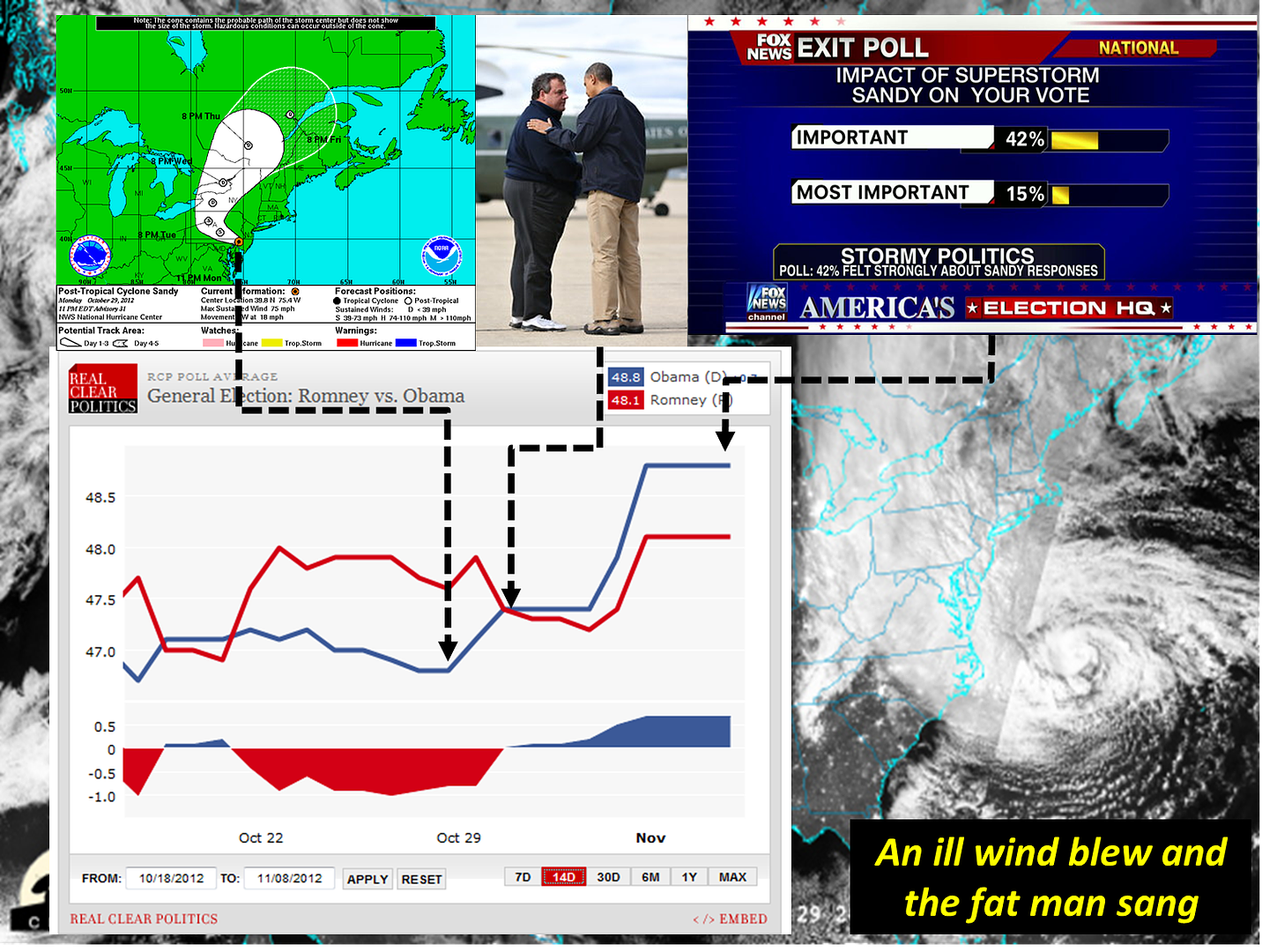
This post of Anthony’s inspired to compose this graphical illustration of how “an ill wind blew and the fat man sang”…

Figure 1. Post-Tropical Cyclone Sandy Storm Track Map (NOAA/NWS), President Obama & Gov. Christie (Washington Post), Fox News Exit Poll (WUWT), RCP Poll Average (Real Clear Politics) and Sandy’s landfall (CIMSS/Univ. Wisconsin-Madison/NASA/NOAA via WUWT).

Acting like the president for four days out of the last four years turned the tide… And a good Envirostatist never lets a “serious crisis to go to waste”…

America’s Choice 2012

Climate change is back on the table
By Steve Hargreaves @CNNMoney November 7, 2012

NEW YORK (CNNMoney) — Climate change is once again a hot topic in the Untied States.

Hurricane Sandy brought the issue back into the spotlight just days before the presidential election. Pundits were quick to note the irony of a massive superstorm striking after three presidential debates that didn’t mention climate change once.

After the storm, New York Mayor Michael Bloomberg evoked the issue again, pointing to climate change specifically in an unexpected, last-minute endorsement of President Obama.

And if there was any lingering doubt about the issue being back in the limelight, the president dispelled it Tuesday night by mentioning global warming in his acceptance speech alongside other priorities like budget and tax reform.

“We want our children to live in an America that isn’t burdened by debt, that isn’t weakened by inequality, that isn’t threatened by the destructive power of a warming planet,” he said.

[...]

CNN Money

Never minding the fact that extra-tropical cyclone Sandy was anything but unprecedented; nor was it the new normal, the storm and President Obama’s appearance of competence were apparently enough to sway about 3% of the electorate. So, no doubt, Mr. Obama and his merry band of Envirostatists will be repeating this page from their playbook…


Election Day 2012: An ill wind blew and the fat man sang!

“The 1000 year Australian hockey itch”

May 17, 2012

The 1000 year Australian hockey itch

From the University of Melbourne, I’m sure Julia and Flannery are thrilled at this paleo-reconstruction, and of course, the blame goes on Mann, er man. I find it interesting though that the lead author, Dr Joelle Gergis, thinks of his science work as a “guerrilla war”.

[...]

Watts Up With That

See Cook et al., 2000

With the collection and dating of additional sub-fossil Huon pine wood from Mt. Read, Cook et al. (1996a) extended the Tasmanian temperature reconstruction back to 800 BC. New spectral analyses of this 2792-year reconstruction again verified the probable existence of the previously identified inter-decadal and century-scale oscillatory modes, now with mean periods of 31, 56, 78, and 200 years. Using singular spectrum analysis (Vautard et al. 1992), Cook et al. (1996a) showed that these oscillatory modes were present throughout the record, but were strongly amplitude modulated. Collectively, they explained about 12% ofthe variance in the unfiltered temperature reconstructionand about 41% of variance in the 10-year low-pass filtered reconstruction. Interestingly, these modes could also account for approximately 51% of the warming over Tasmania since 1965, with the remaining 49% due to other processes. Finally, Cook et al. (1996a) showed how these natural oscillatory modes could theoretically mask future warming trends over Tasmania due to greenhouse gas forcing.

“New spectral analyses of this 2792-year reconstruction again verified the probable existence of the previously identified inter-decadal and century-scale oscillatory modes, now with mean periods of 31, 56, 78, and 200 years.”

Reconstructions are built from real data (AKA observations). The *real data* “again verified the probable existence of the previously identified inter-decadal and century-scale oscillatory modes, now with mean periods of 31, 56, 78, and 200 years.”

A 200-yr “century-scale” oscillation would look a lot like a “long-term trend” to people unfamliar with spectral analyses. Like this:

I used a tree ring reconstruction from Mt. Read and the instrumental record from Hobart Airport…

To build a quick warm season climate reconstruction for Tasmania over the last ~3,600 years…

The last 60 years may very well have been the warmest 60-yr period over the last millenium. It might be 0.1°C than the 60-yr peak in the early 1400′s. So what?

Prior to the Little Ice Age, these sort of peaks were hit roughly once every 200 years. The peaks were anywhere from 15.2-15.5°C. The average temperature at Hobart Airport over its 54-yr record is 15.5°C.

The Little Ice Age was possibly the coldest part of the Holocene since the 8.2 KYA Cooling Event. The LIA was cold because the millennial-scale cycle was in its cold phase and there was an anomalous periof of volcanic activity ca 1200-1400 AD, most notably the ca 1300 AD eruption of El Chichón.

From the Guardian article

Dr Steven Phipps, from the Climate Change Research Centre at the University of New South Wales, who carried out the modeling, said the study demonstrated strong human influence on the climate in the region.

“The models showed that prior to 1850 there were not any long-term trends and temperature variations were likely to be caused by natural climate variability which is a random process,” he said.

“But [the modeling showed] 20th-century warming significantly exceeds the amplitude of natural climate variability and demonstrates that the recent warming experience in Australia is unprecedented within the context of the last millennium.”

Modeling will show whatever the modeler wants it to show.

The paper is pretty interesting. Here’s their proxy reconstruction ensemble:

One of the things that immediately caught my eye was the fact that the onset of the anomalous warming in their mult-proxy reconstruction coincided with the anomalously cold period in the early 1900′sand that when I plot their reconstruction on my much longer reconstruction, the last 60 years do not appear anomalous at all.

Gergis et al. have once again rediscovered the warm-up from the Little Ice Age.

Why William D. Nordhaus Is Wrong About Global Warming Skeptics Being Wrong…

March 2, 2012

William D. Nordhaus is an economics professor at Yale University.  He recently published this essay in the New York Review of Books

Why the Global Warming Skeptics Are Wrong

March 22, 2012

William D. Nordhaus

nprdhaus_1-032212.jpg

Olaf Otto Becker

Icebergs in Iceland’s Jökulsárlón lagoon, which is constantly growing as the Vatnajökull glacier—Europe’s largest—melts; photograph by Olaf Otto Becker from his book Under the Nordic Light: A Journey Through Time, Iceland, 1999–2011, which has just been published by Hatje Cantz

The threat of climate change is an increasingly important environmental issue for the globe. Because the economic questions involved have received relatively little attention, I have been writing a nontechnical book for people who would like to see how market-based approaches could be used to formulate policy on climate change. When I showed an early draft to colleagues, their response was that I had left out the arguments of skeptics about climate change, and I accordingly addressed this at length.

But one of the difficulties I found in examining the views of climate skeptics is that they are scattered widely in blogs, talks, and pamphlets. Then, I saw an opinion piece in The Wall Street Journal of January 27, 2012, by a group of sixteen scientists, entitled “No Need to Panic About Global Warming.” This is useful because it contains many of the standard criticisms in a succinct statement. The basic message of the article is that the globe is not warming, that dissident voices are being suppressed, and that delaying policies to slow climate change for fifty years will have no serious economic or environment consequences.

My response is primarily designed to correct their misleading description of my own research; but it also is directed more broadly at their attempt to discredit scientists and scientific research on climate change.1 I have identified six key issues that are raised in the article, and I provide commentary about their substance and accuracy. They are:

• Is the planet in fact warming?

• Are human influences an important contributor to warming?

• Is carbon dioxide a pollutant?

• Are we seeing a regime of fear for skeptical climate scientists?

• Are the views of mainstream climate scientists driven primarily by the desire for financial gain?

• Is it true that more carbon dioxide and additional warming will be beneficial?

[...]

New York Review of Books

Professor Nordhaus then proceeds to address his six strawmen answer his own questions.

(more…)

Warming Island / Greenland Sea Regional Climate and Arctic Sea Ice Reconstruction

September 19, 2011

The recent return of the Warming Island AGW myth inspired me to build a climate reconstruction for the Greenland Sea region.

Temperature Reconstruction

I performed a GISS station search centered on 71.4 N latitude, 23.5 W longitude and downloaded the 12 GISS/GHCN instrumental records with at least 60 years of continuous data up to 2011.  

Fig. 1) Station Location Map

Next I calculated a temperature anomaly relative to 1961-1990 for each of the 12 stations and then averaged them together to create a temperature reconstruction.  The climate in the Warming Island area is statistically indistinguishable from that of the 1930′s.

Fig. 2) Warming Island Area: Instrumental temperature reconstruction.

Then I took that reconstruction back to 1000 AD with the GISP2 ice core d18O data (Kobashi et al., 2010)…

Fig. 3) Warming Island Area: Instrumental reconstruction combined with GISP2 ice core reconstruction.

The Modern Warming is also statistically indistinguishable from the Medieval Warm Period in the Warming Island region.

Arctic Sea Ice Reconstruction

It occurred to me that there might just be a relationship between the temperature anomaly and the Arctic sea ice extent.  So I went to Wood for Trees and downloaded the historical  NSIDC Arctic Sea Ice Index.  Then I cross plotted an annual 13-month running average of the sea ice index against the average of the station anomalies and the GISP2 reconstruction (Kobashi et al., 2010) and found a pretty good correlation (R-squared = 0.67)…

Fig. 4) Warming Island Temperature Anomaly vs. NSIDC Arctic Sea Ice Index.

Using the equation “Sea Ice Index = (-0.5976 * Temp. Anom.)+12.374″ I calculated a Model Sea Ice Index.

The “Model Sea Ice Index” (white curve) is very similar to the measured sea ice index (cyan curve)…

Fig. 5) Arctic Sea Ice Extent Model: 1880 AD to present.

Using the same equation, I extrapolated the Model Sea Ice Index back to 1000 AD using the GISP2 temperature data from Kobashi et al., 2010…

Fig. 6) Arctic Sea Ice Extent Model: 1000 AD to present.

The model suggests that Arctic sea ice had been steadily expanding from ca. 1150 AD up until ca. 1800 AD and has been declining since ca. 1800 AD.

Next, I carried the model back to the Early Holocene using the Alley, 2000 GISP2 reconstruction…

Fig. 7) Arctic Sea Ice Extent Model: Holocene

This suggests that the sea ice contraction during the instrumental era (1979-2011) is not particularly remarkable.

Calibrating the Model

Realizing that my model has been extrapolated about 8,000 years away from real data, I decided to compare it to some real data. McKay et al., 2008 demonstrated that the modern Arctic sea ice cover is anomalously high and the Arctic summer sea surface temperature is anomalously low relative to the rest of the Holocene…

Modern sea-ice cover in the study area, expressed here as the number of months/year with >50% coverage, averages 10.6 ±1.2 months/year… Present day SST and SSS in August are 1.1 ± 2.4 8C and 28.5 ±1.3, respectively… In the Holocene record of core HLY0501-05, sea-ice cover has ranged between 5.5 and 9 months/year, summer SSS has varied between 22 and 30, and summer SST has ranged from 3 to 7.5 8C (Fig. 7).

McKay et al., 2008

Fig. 8) Chukchi Sea Ice Extent: Holocene.

My GISP2 (Alley, 2000) sea ice model is generally consistent with McKay et al., 2008…

Fig. 9) Comparison of Arctic sea ice extent model to Chukchi Sea ice cover.


 Conclusion

“Move along, there’s nothing to see here.”  The Arctic sea ice has “been there and done that” many times over the last 10,000 years without any anthropogenic assistance.


References 

Alley, R.B. 2000.  The Younger Dryas cold interval as viewed from central Greenland. Quaternary Science Reviews 19:213-226.

Kobashi, T., J.P. Severinghaus, J.-M. Barnola, K. Kawamura, T. Carter, and T. Nakaegawa.  2010. Persistent multi-decadal Greenland temperature fluctuation  through the last millennium. Climatic Change, Vol. 100, pp. 733-756. 

McKay, J.L., A. de Vernal, C. Hillaire-Marcel, C. Not, L. Polyak, and D. Darby.  2008. Holocene fluctuations in Arctic sea-ice cover: dinocyst-based reconstructions for the eastern Chukchi Sea. Can. J. Earth Sci. 45: 1377–1397

Michaels, P.  2008. “Warming Island”—Another Global Warming Myth Exposed. World Climate Report.


What a difference a year can make!!!

June 10, 2011

The BBC article goes on to say…

If a trend meets the 95% threshold, it basically means that the odds of it being down to chance are less than one in 20.

Last year’s analysis, which went to 2009, did not reach this threshold; but adding data for 2010 takes it over the line.

“The trend over the period 1995-2009 was significant at the 90% level, but wasn’t significant at the standard 95% level that people use,” Professor Jones told BBC News.

“Basically what’s changed is one more year [of data]. That period 1995-2009 was just 15 years – and because of the uncertainty in estimating trends over short periods, an extra year has made that trend significant at the 95% level which is the traditional threshold that statisticians have used for many years.

“It just shows the difficulty of achieving significance with a short time series, and that’s why longer series – 20 or 30 years – would be a much better way of estimating trends and getting significance on a consistent basis.”

Professor Jones’ previous comment, from a BBC interview in February 2010, is routinely quoted – erroneously – as demonstration that the Earth’s surface temperature is not rising. (more…)


Follow

Get every new post delivered to your Inbox.